
On the Before and After

 Posted by on March 11, 2013
Mar 112013
 
Before leaving and after leaving

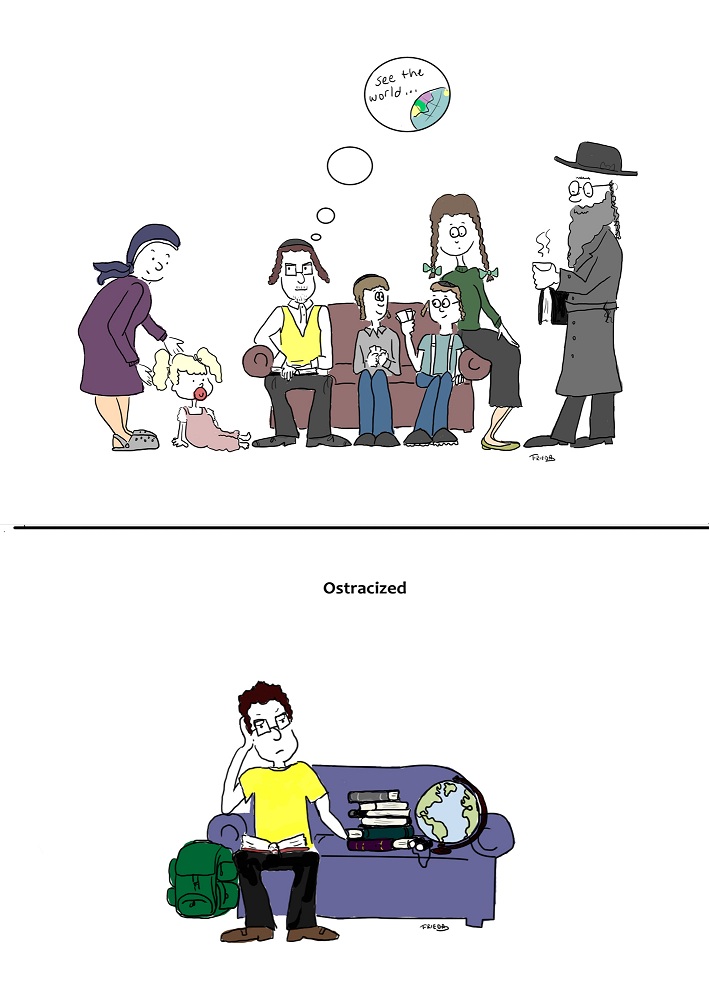
This cartoon was commissioned; I was asked to draw a before and after with approximate instructions. When it was done, I immediately worried about the before. The family looks too warm and sane. Doesn’t the official “before” picture come with an abusive rabbi in a dark basement or some dysfunctional family which festers dark secrets behind closed doors?

I suppose, I thought, after my pencil had brought to life a crowded and safe home, for me this is how I remember it. A religious childhood home can be safe, and warm and rich with tradition and it can still be stifling and oppressive and limited. It’s what makes leaving so damn hard.

Most of the time the journey from Hasidism out is depicted in a before and after template, the before picture consisting of a droopy nosed Hasid in a wild beard and a bride in frightening eighties wedding gown and hair that stands as wide as the shoulder pads. The after picture is glorified by a full shave, a target tshirt, the dippity do from the payos now in the hair. All of it, the critics say, very superficial.

So I took it upon myself to conduct a longitudinal survey with forty samples and find out what their before and after is like in words. The scientific approach behind it was to post the question on facebook and ask people to describe their before and after. The first thing the study proved is that OTDs are a group of wise guys

On the Times

 Posted by on March 2, 2013
Mar 022013
 

A woman looking at her watch can't believe it's 2012 already

It’s not 1896! Take off that chinush jabot, mammele, and get with the times!

In some ways, Hasidim are completely stuck in the past. They behave, dress, speak, experience culture and observe Yiddishkeit as if it were two centuries ago. In other ways, they are masters of modernity, technology and fashion. I can’t completely make sense of this contradiction.

There is no doubt that even if Hasidim tried to resist the times, the explosion of advancements in the last two hundred years has made it nearly impossible to do so. And Hasidim aren’t foregoing opportunities to exploit these advancements for their own good either. Where technology can aid religiosity, be it to detect some living germs on lettuce or to send lab analysis of Rabbi’s voice recordings to prove authorship, the role technology plays in Hasidic life is significant. Unlike the Amish, there’s no shying away from onslaught of technology. Instead, Hasidim modify it and adopt it.

The new theory I am developing is that the Hasidic society survives by a system of Structured Adoption (henceforward… ehhem…SA). This means that Hasidim adopt outside ideas but in extremely specific and limited ways. Whenever change or progress is made in the secular world, these changes affect the Hasidic community. There is initially some floundering and struggles to adopt these influences in ways that don’t threaten pious seclusion, but after a while leaders legalize a form of structured adoption (SA, like I said!). For example, thirty years ago our parents had much more liberty in dress and behavior, even in Satmar. After some time, the Satmar Rebbe codified the Satmar American dress code, devising for instance, specific Palm tights, and from that point on Western dress became a non-threatening expression of fashion in a particularly Hasidic way. The adoption became more structured when t-shirts were ruled unkosher except under a shirt or over a shirt.

A current example would be when a new hairstyle is released or a new style of music arrives on the scene. Rabbis and the people are ambivalent about what goes and what doesn’t, but after some contradictory stances rabbis pretty much codify the exact stance, i.e., new music by Lipa is assur but by Weber is ok, the Rachel Cut is okay, but reaching below the shoulder is not. These structured adoptions (SA!) help Hasidism survive as they are also changing.

It is yet to be seen if my theory will hold with the biggest threat to Hasidism: internet.

PS: I’d originally really wanted to do this cartoon with a rebbeh at his tish instead of a chasunadika lady, but submitted that it would be entirely unrealistic for a rebbeh to use a modernity like a wristwatch.